
Diagnostics are our first line of defence
Pandemics are extraordinarily complicated. Stopping their spread is, at least in principle, simple. As soon as we discover an ongoing outbreak, we need to:
- Find out who is infected.
- Find out who they have been in contact with.
- Isolate/treat them before they infect somebody else.
Repeat this process faster than the pathogen can spread.
At the start of 2020, there were no vaccines or effective antivirals for COVID‑19. Testing was one of the few tools governments had that could immediately interrupt the transmission chain. The problem was: how do you test entire countries quickly enough?
COVID-19 showed the cost of losing that race: nearly 15 million excess deaths worldwide in the first two years.
A Tale of Two Tests
On 31 December 2019, a cluster of pneumonia cases with no known cause was reported in Wuhan. Within a week, Chinese authorities had identified a novel coronavirus. Sequencing a single patient sample gave us its whole genome, and by 10 January 2020, just ten days after the outbreak was first reported, that sequence was posted publicly.
At that point, the problem changed. We knew we had a novel pathogen on our hands, and we knew its genetic sequence. It was time to design a test to find out how far the virus had already spread. The obvious first approach was a standard lab technique known as polymerase chain reaction (PCR). Scientists make short pieces of genetic material called primers that match a sequence unique to the virus. If it is present in a patient’s sample, PCR uses those primers to copy it until there is enough to detect. PCR turns genetic information directly into a test.
By 23 January, just thirteen days after the genome became public, researchers had published a working PCR protocol. We had identified the virus and designed a test for it almost immediately.
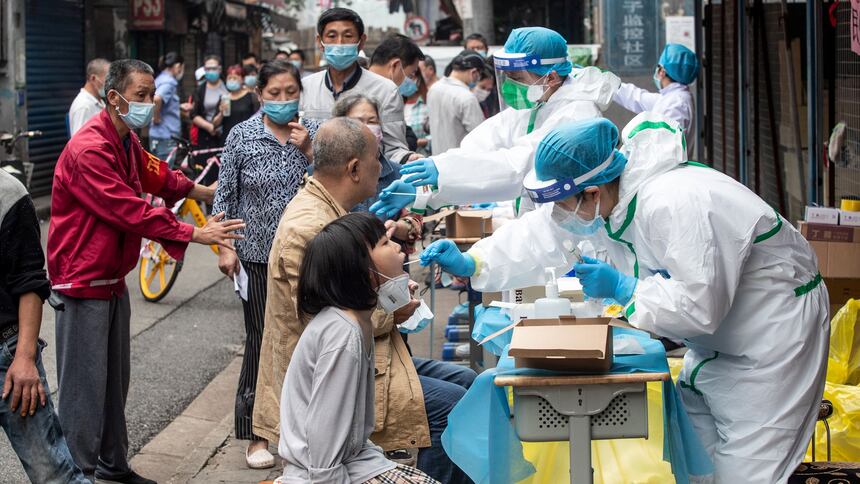
This was the test that many people remember having to leave home for; you travelled to a testing site, queued with potentially infected people for a swab, and then waited, sometimes several days, for the result to come back from a central laboratory.1
Samples had to be labelled, packaged, transported to a laboratory, processed by trained staff and then run on specialist equipment. CDC guidance at the time also called for samples to be kept refrigerated, or frozen if testing or shipping was delayed.
Designing a PCR test and actually testing an entire population with PCR were two very different problems.
Every test depended on near-perfect orchestration of people, transport, reagents and laboratory capacity. Getting that capability everywhere it was needed became the bottleneck. Slow turnaround created another problem: while waiting a day or two for a result, an infected person could continue spreading the virus.
In November 2020, Liverpool began the UK’s first city-wide testing pilot, offering tests to people even if they had no symptoms. Alongside PCR, the programme used a different technology: lateral flow tests.
You will probably remember these as the small plastic tests you later used at home, waiting for a line to appear. Unlike PCR, which looks for the virus’s genetic material, these tests look for its proteins. Inside is a paper-like strip containing antibodies: molecules that bind to a particular viral protein. As the sample flows along the strip, these antibodies capture the protein and a visible red line forms if enough viral protein is present. The result appears in minutes with no lab needed.2
Lateral flow soon became the most widely used test in England. By the first week of February 2021, daily lateral flow testing had overtaken PCR. At the Omicron variant peak in early January 2022, England was running about 1.24 million lateral flow tests a day against 670,000 PCR tests.
Those figures also strongly understate how widely lateral flow tests were used. The vast majority of people took tests without reporting the results online, particularly when they were negative. Estimates suggest that 175 million tests were taken in England in January 2022 alone, roughly five times the number officially registered. In a national survey in the United States, nearly a quarter of people who used the government’s free home tests said they would have been unlikely to test without them. Making testing frictionless brought more people into reach, giving us chances to find hidden infections before they spread.
The payoff of introducing lateral flow tests was more than just a quicker time to result. In its first six weeks, Liverpool’s city-wide pilot was associated with an estimated 21% fewer cases than in similar areas without the programme. The benefit also appeared in hospitals: 25% fewer COVID-19 admissions between November 2020 and January 2021, after accounting for differences in local restrictions.
Pandemics are a multiparameter problem, but these results strongly suggest that quick, accessible testing helped reduce transmission and keep people out of hospital. Nice!
Looking at the graph above, the benefits of lateral flow only came many months into the pandemic. If these tests could reach more people and help reduce transmission, why had we waited so long to deploy them?
Why so sensitive?
One major objection was that lateral flow tests were less analytically sensitive than PCR. This means they needed more viral material in a patient sample to turn positive, raising concerns that they would miss infections.3
But that comparison treats testing as a one-off event. What happens if people can test repeatedly?
Computational modelling early in the pandemic compared two tests, one that could detect small amounts of viral material and another that required a hundred times more material to show as positive. The researchers changed the frequency at which people tested and how long they had to wait to get results back. The conclusion was that frequent testing with immediate results could reduce transmission more effectively than a more analytically sensitive test used less often or with a delayed answer.
This is because a test only takes a snapshot of an infection that is still changing. During acute respiratory infections such as influenza and COVID-19, the amount of viral material in an infected person rises very quickly. This means it may take only a short time for an infection detectable by PCR to become detectable by a less sensitive lateral flow test. A human challenge study, which is one where participants are intentionally exposed to live virus to understand how infection progresses, confirms this mechanism. Lateral flow tests became positive one to two days after PCR.
What’s interesting is that a test did not have to catch every infection on the first attempt to be useful. Among people whose samples contained infectious virus but whose lateral flow test was initially negative, 17 out of 29 tested positive the following day. Being able to test again helped make up for what the first test missed.
Therefore, lateral flow turns positive 1.1 days after PCR.
Nasal viral load in six participants, measured twice daily.
About the measurements
All six participants with sustained infections in Lindeboom et al. (2024), using days 1–15 when all six had samples. The dark line is the median of the reported log-scale values. Lines connect samples without smoothing.
The study assigns plotting values of 1.5 to detected but unquantifiable samples and 0 to undetected samples. These low values are not measured concentrations. The dashed line marks the study’s quantification limit.
Frequent testing also has to fit into everyday life. Travelling to a testing site and queuing makes PCR harder to repeat, even from just a behavioural standpoint. A lateral flow test can be taken at home, with a result in minutes. An infection detected in Monday’s PCR sample might not be reported until Wednesday. A lateral flow test repeated on Tuesday could give someone an answer that morning, allowing them to act a day sooner.
There is another reason sensitivity alone is an incomplete measure of usefulness. PCR can detect leftover genetic material well after the infectious period has ended. For COVID, it can remain positive for up to 90 days after the first positive result. Treating every lingering positive as evidence of contagiousness could therefore keep people isolated unnecessarily. Lateral flow is less likely to pick up these lingering traces, so a positive result can be more useful for identifying people who may still be infectious.
The aim is to find people early enough to interrupt transmission. For that purpose, how often people can test and how quickly they get a result can matter more than the smallest amount of virus a test can detect.
Why the best test arrived last
So lateral flow had some pretty clear advantages for reducing population-level transmission. Why did it take so long to reach people? We knew the genetic sequence of SARS-CoV-2 in January 2020, yet Slovakia only began the world’s first nationwide mass lateral flow testing campaign at the end of October, nearly ten months later. We had already mastered manufacturing and deployment of this test format at scale: ubiquitous lateral flow-based pregnancy tests have been sold since 1988.
But a pregnancy test cannot recognise a new virus using the same antibodies. We needed new molecules that could recognise the viral protein and work reliably in the final test format. One conventional route to find antibodies that do this reliably uses an animal’s immune system to generate candidates, followed by several stages of development:
-
Generate antibodies. An animal, commonly a mouse or rabbit, is immunised with the target protein or a fragment of it.
-
Identify useful candidates. Researchers examine the resulting antibodies for recognition of the intended target and unwanted binding to other material.
-
Establish a reproducible supply. Selected antibody-producing cells are grown in culture to make consistent copies. We are effectively taking part of a mammal’s immune system and putting it to work outside the animal.4
-
Evaluate them in the actual test. The antibodies must work together in the lateral flow format and give dependable results with real patient samples.
Developers can also start with existing antibodies or use other discovery methods. Turning that recognition into a working viral sensor at someone’s kitchen table is still a monumental engineering challenge and there are a plethora of iterations to be done on the downstream chemistry.
There were other barriers too. Developers needed patient samples to validate their tests, regulatory approval, and funding to expand manufacturing, all areas highlighted by the G7 preparedness report.
There are already concrete proposals for regulatory reform. The Institute for Progress argues that public-health screening tests should be assessed on speed, accessibility and their ability to reduce transmission, alongside accuracy. Putting those proposals into practice would help align regulation with what we need these tests to achieve.
But the recognition molecule is a prerequisite for the whole process. Making it easier to develop would give us a faster way to adapt a test format we already know how to use and make at scale.
Reprogrammable Biosensors
PCR enables you to go from a viral genome to a centralised lab test in days.
Genome → primers → laboratory result
At AminoAnalytica, we are building an autonomous system to go from viral genome to field deployable biosensor in days.
Genome → designed recognition molecules → on-site result
Advances in computational biology and autonomous lab infrastructure make this possible.
The scale of demand is explicit in BARDA’s strategic plan:
“…deploy over 100 million human pathogen-specific diagnostic tests, within 45 days (and every 30 days thereafter) of declaration of a public health emergency and access to the genome sequence.”
— BARDA Strategic Plan 2022–2026, Objective 2.2
Those tests would also need replenishing as they expire, alongside checks and updates as pathogens evolve, keeping stockpiles ready for the next outbreak.
We already have manufacturing infrastructure for familiar formats such as pregnancy tests. Building for that same infrastructure and “hot swapping” a traditional recognition molecule for a computationally designed biorecognition element, validated for the new target, gives us a practical route towards those volumes.
The cost per test matters because it determines how often people can test during a pandemic. Affordable biosensors make repeated testing possible, including in low- and middle-income countries. That benefits everyone: pandemics are a cross-border problem, so helping others detect and contain outbreaks also protects us. That need for global coordination sharply contrasts with the competitive nature of traditional defence tech: wider access to detection strengthens our shared protection.
Where we manufacture these molecules matters too. Small, designed proteins can be produced in E. coli, reducing reliance on the specialised mammalian cell culture facilities used to produce conventional antibodies. This opens routes to decentralised production as well as detection.
Antibodies also account for nearly half the material cost of a lateral flow strip. Swapping them for small, computationally designed biorecognition elements reduces that cost in two ways: cheaper production and more binding sites per gram. A representative 7 kDa miniprotein provides roughly ten times as many binding sites per gram as a 150 kDa antibody. Together, these advantages dramatically reduce the cost of the recognition molecules used on each strip.
Weather for Viruses
If biological recognition becomes inexpensive and adaptable, how much of the world would we choose to measure routinely?
Think Jevons’ paradox for diagnostics: as detection becomes more affordable, we could routinely monitor human diseases, diseases in crops and livestock, and even our own biomarkers.
And what if we connected the results of all those tests, recording where and when each was taken?
We already all carry a powerful optical sensor in our pockets: our phones. Analysing the test line with its camera can not only improve sensitivity but also begin to provide a quantitative readout. Sharing those results across homes, clinics and farms could reveal patterns of pathogen circulation that no single test could uncover. Someone described this back to me as “weather for viruses”, so that’s now my response when people ask what we’re building!
A laboratory identifies a new strain in a person after animal exposure.
Urbanisation, agriculture and habitat destruction bring people into closer contact with wildlife and the pathogens they carry. An outbreak of rodent-borne hantavirus aboard the MV Hondius, reported in May 2026, prompted contact tracing across 33 countries and territories.
As infections cross borders, testing has to keep pace. A test developed in days could feed results into a shared case map in real time, helping teams coordinate contact testing nationally and internationally, and isolate infected people before they pass the virus on.
But we need not wait for another pandemic for this to matter. Intercept are right to make the case that we have become too accepting of the burden of everyday respiratory infections. Better detection will enable us to act against diseases we already live with, as well as those we fear might emerge.
AI adds another concern. There is very fierce debate regarding the future threat landscape of biological weapons, part of the broader argument over frontier capabilities raised by Dario Amodei in We Must Pace the Frontier. Open-weight models are following close behind the leading closed models, raising an uncomfortable question: what happens when comparable capabilities become available without the safeguards and oversight applied by frontier providers?
That debate deserves an essay of its own. But the case for better biological defences does not depend on resolving it. Naturally occurring outbreaks already justify the investment; having that infrastructure in place only strengthens our protection against engineered threats.
That brings us back to the race we started with: finding infections and helping people act before they spread further.
The next pandemic should not begin with us scrambling to build the tools required to see it. We need to have the sensing layer already in place.